Sunday, January 25, 2009

2009 Pagani Zonda R


The Zonda R is born with full liberty. The target: the ultimate performance at the racetrack without any implications of rules, except for safety, where no compromise is allowed.

In September 2006 the first drawings were ready, but it was crucial to have the support of Mercedes-AMG for a high revving engine with a power output of 750hp, dry sump, light and with a low centre of gravity. The basis was the self supporting engine of the mighty CLK GTR, which has dominated the GT championships.

Eve at constant racing pace the engine would have to cover over 5.000 km before servicing. The challenge has been accepted without hesitation.

The Zonda R is a car designed from scratch, with only 10% of the Zonda F components to be carried over. The suspension forged in Avional, a new Pagani six speed transversal sequential gearbox, carbon fibre monocoque, aeronautical four pump fuel tank are only part of the equation.

The wheelbase has grown by 47mm, the overall length by 394mm and the track is increased by 50mm. The bodywork and aerodynamics have been studied to offer maximum downforce. Even though built for the track, the project would not have received kick off, if the quality and finish of the car and its details was not up to the level of the Pagani road cars.

One of the first cars to be delivered however will be kept in a living room, designed by Pagani and built with the same materials as the Zonda F, beautifully textured carbon fibre, avional, titanium, inconel and other state of the art materials. Additionally it will feature a bespoke HiFi System that will allow the customer to listen to the sound of this car at Le Mans and the Nürburgring.

Saturday, January 24, 2009

2009 Mitsubishi Lancer Ralliart


The new Mitsubishi Lancer Ralliart reinforces the sporty identity of the Lancer lineup with aggressive styling and driving performance that creates a unique product between the Lancer GTS 2.4 and the Lancer Evolution models. The Mitsubishi Lancer Ralliart makes effective use of the Lancer’s rigid unibody and four-wheel independent suspension by mating this capable chassis to a turbocharged engine and all-wheel-drive.


Mitsubishi Lancer Ralliart is powered by the new 4B11 2.0-liter DOHC MIVEC intercooled and turbocharged engine (also used in the Lancer Evolution) that develops an estimated 235 horsepower. The engine is mated to Mitsubishi’s efficient Twin Clutch-SST gearbox that helps enhance the sporty nature of the vehicle by allowing the driver to execute lightning-quick, silky-smooth, paddle-actuated shifts. The TC-SST transmission also operates in fully automatic modes for Normal and Sport driving conditions.

The Mitsubishi Lancer Ralliart’s full-time 4WD driveline features Mitsubishi’s Active Center Differential (ACD). The ACD unit employs an electronically controlled multi-plate clutch center differential, vectoring drive torque to the front and rear according to different driving conditions to realize the best balance between steering response and traction characteristics on Tarmac, Gravel, or Snow surfaces.

Mitsubishi Lancer Ralliart is also equipped with front helical limited slip differential and a rear differential mechanical limited slip differential.

Elaborating on the basic sporty design and proportions of the Lancer, the Mitsubishi Lancer Ralliart exterior is distinguished by its more aggressively styled front bumper design, rear bumper cover, dual outlet muffler and a lightweight aluminum, ducted hood that delivers cooling air to the turbocharger.

The interior design places greater emphasis on function and vehicle control. Mitsubishi Lancer Ralliart is equipped with FAST key, Bluetooth® hands-free telephone interface, the same Twin Clutch-SST shifter used on Lancer Evolution, and easily accessible steering column mounted paddle shifters.

Available equipment and options to include: Recaro seats, HID headlights, 650-watt Rockford Fosgate 9-speaker audio system, Sirius satellite radio, power sunroof, and a 30-gigabyte hard drive navigation system with digital music server.

Tuesday, January 20, 2009

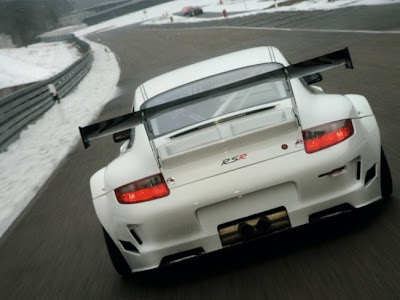
2009 Porsche 911 GT3 RSR


The successful Porsche 911 GT3 RSR takes off into the new model year with extensive modifications. The most powerful race car based on the Porsche 911, which last season secured wins in the American Le Mans Series and at the Nürburgring 24 Hours, competes in the GT2 class at international long distance races. The most distinguishing feature of the new GT3 RSR is the redesigned front with large air outlets on the front hood. Under the light-weight bodyshell, as well, major changes were made to the quickest 911.

Noticeable at first sight are the air outlet slots, or the so-called louvers, on the front hood: an indication of the completely redesigned air ducting of the radiators, which became necessary through the new design of supply and discharge air with the installation of an optional air-conditioning unit. The aerodynamics under the rear underwent further optimisation. The rear wing now features a wider adjustment range. The weight-optimised brake system and the lighter wiring harness contribute to further improved handling, compared to the predecessor model.

The capacity of the well-known six-cylinder boxer engine increased from 3.8 to 4.0-litres. After another reduction in the size of the air restrictors for the 2009 season, the engine now delivers around 450 hp (331 kW) at 7,800 revs per minute and develops a maximum torque of 430 Nm at 7,250 rpm. The rev limiter of the efficient six-cylinder unit kicks in at 9,000 rpm. Compared to the forerunner, the rev level for a given power output was significantly lowered. Thanks to this, the engine features an optimised torque curve and offers better driveability.

In the cockpit, a new multi-function display located above the dashboard indicates the opti-mum moment to change gears. Another new feature is the programmable multi-function, onboard supply system control device, giving teams the choice of many individual functions. One of these is the infinitely adjustable blinking frequency of the lights in the front apron, which helps to immediately recognise race cars when they enter the pits in the dark. For easier servicing under race conditions, other modifications were made. The GT3 RSR now features a new air-jack system with overpressure valve. The oil refill with fast filling function has now moved to the rear lid, giving mechanics better access.

Aside from GT3 Cup and the GT3 Cup S, the GT3 RSR is the third race car based on the Porsche 911 offered by Porsche Motorsport. About 20 of the successful long distance racers have been built in Weissach and are now being delivered to customer teams around the world. The GT3 RSR costs 380,000 Euro plus VAT specific to each country.

Monday, January 19, 2009

2009 Farbio Track Day Car


Farbio Sports Car announce their lightweight 2009 Track Day Car, weighing in at a nimble 956kg with 350 bhp, giving a phenomenal 366 bhp/ton power to weight ratio!

This model is a limited edition of 25 cars and is based on the GTS350 Supercharged model with intercooler and upgraded injectors. The car is sold as a base unit and has a list of options to customise the car, as it has been designed with a minimalist interior specification to maximise weight reduction.


The car retains its carbon fibre body and has the addition of a fuel bag tank, uprated gearbox with limited slip differential, dry sump and low profile Toyo R888 tyres. The Track Day Car will be road legal unless it is built specifically for racing i.e. with the inclusion of the FIA approved roll cage.

Higher engine options are available for the serious racing enthusiast, with the potential of 450 bhp, giving a staggering power to weight ratio of 471 bhp/ton!

All cars are made to order to the individual’s specification.

Saturday, January 17, 2009

2010 Lotus Evora


The first all-new Lotus since the iconic Elise made its debut in 1995, The Evora enters the sports car market as currently the world’s only mid-engined 2+2. Powered by a Lotus-tuned 3.5-litre V6 engine producing 280 PS, and weighing just 1350 kg (prototype specification), the Evora promises breathtaking performance. During preliminary testing around the famous Nürburgring, the Lotus chassis engineers report that it is extremely agile and great fun to drive – even when clad with the full development disguise that hid the beautiful lines from the prying motor-industry paparazzi.


In addition to its excellent performance and exemplary handling, the Evora offers a more refined ownership experience than Lotus’s existing smaller four-cylinder models. Its elegantly styled cabin is elegantly trimmed and its equipment list includes contemporary features such as an advanced touch-screen multi-media system and electric power-fold door mirrors.

Because one of the roles of the Evora is to attract new customers to the Lotus brand, much attention has been paid to its ease of use. Wider, taller door apertures and narrower sills make getting in and out of the cabin a less athletic undertaking than it is in Lotus’s smaller sports cars (the Elise, Exige, Europa and 2-Eleven), while the design of the cabin itself will accommodate two 99th percentile (6ft 5in tall) American males in the front seats.


The ‘convenience factor’ of the Evora extends to less obvious areas of the car. For instance, beneath the skin the entire front-end structure is a high tech aluminium sacrificial modular unit, attached to the main extruded aluminium tub. This modular unit is designed to deform for maximum safety, and to reduce repair costs in the event of a frontal impact.

The Evora has been designed with global automotive regulations in mind, and future derivatives are planed, these including amongst others, a convertible.

The Evora will be hand crafted and built on a dedicated new assembly line within Lotus’s advanced manufacturing facility at Hethel in the east of England; capacity limitations will restrict production to approximately 2000 cars a year, ensuring the dynamic new sports car’s rarity and exclusivity.

2009 Dodge Circuit EV


The Dodge Circuit EV design screams pure sports car from every angle. The Dodge Circuit EV’s profile demonstrates perfect proportions for balanced handling, placing the driver and passenger midway along the wheelbase. At the front of the vehicle, the distinctive Dodge crosshair grille splits the wind, sending it over the long, low hood and cleanly over the windshield and cockpit. The body sides feature a deep scallop, providing visual depth and also a functional rear-brake air duct. At the rear, the functional elements blend with design to create a uniform finish.

“The exterior styling of the Dodge Circuit EV mates bold Dodge styling to the no-compromise performance attributes of an all-electric performance sports car,” said Ralph Gilles, Vice President – Design, Chrysler LLC. “The Dodge Circuit EV offers an extremely fun-to-drive, expressive sports car without fuel consumption and with virtually no impact on the environment.”

The Dodge Circuit EV is adorned in all-new “Tangoreen” exterior color, wearing large “EV” graphics on both sides of the sports car.

The uncomplicated interior of the Dodge Circuit EV delivers a combination of pure function and athletic refinement. The cockpit design puts complete control of the car at the driver’s fingertips. Nestled within a leather-covered instrument cluster are two primary analog-face gauges. A digital display conveys information regarding the electric-drive system.

The seats feature deep bolsters and are covered in premium leather. The same premium leather covers the center console and the width of the instrument panel.

The Dodge Circuit EV delivers all of the convenience features of a performance sports car, including premium sound system, power windows and door locks, air conditioning, speed control.

Thursday, January 15, 2009

2009 Fisker Karma S Concept


Fisker Automotive unveiled the Fisker Karma S concept at the 2009 North American International Auto Show (NAIAS). The four-seat, plug-in hybrid hardtop convertible furthers the company’s belief that driving style and performance need not be compromised for environmental friendliness.


The open-air Fisker Karma S concept shares its aluminum spaceframe architecture and clean Q-DRIVE® powertrain with the Fisker Karma sedan. Designed and engineered by Quantum Technologies exclusively for Fisker Automotive, Q-DRIVE® provides 50 emission-free miles on a single charge to its lithium-ion battery pack, and up to 403hp from two electric motors. The power retractable hard top, a first for Fisker, glides neatly into the trunk and a unique design language sets the Karma S concept apart.